
What Makes a Gel Cure?
Let’s take a look at one ingredient that changes how a gel cures. That ingredient is the photoinitiator. The photoinitiator gets its name from the gel chemistry term initiator. The initiator is triggered by the activator; Ultra Violet Light Energy...
There are many factors that come into play to make high quality gels.
NSI’s gels are specifically formulated with unique combination of several types of oligomers (short pre-formed chains of monomers) which create the structure and backbone of the gel system. Other ingredients include the photoinitator, which jump starts the polymerization process, and adhesion promoters, which help the gel adhere to the natural nail.
Think if how different a recipe would be if you altered the number of eggs or cups of flour. It is the quantities of each of these ingredients and the addition of other substances that make NSI gels unique and proprietary. NSI has created the special “recipe” after numerous formulations.
Let’s take one ingredient that changes how a gel cures. That ingredient is the photoinitiator. The photoinitiator gets its name from the gel chemistry term initiator. The initiator is triggered by the activator; Ultra Violet Light Energy.
PHOTOINITIATORS
Photoinitiators (PIs) are light sensitive and decompose into free radicals to start the polymerization process. PIs absorb UV light and convert it into the energy needed to drive the polymerization process (UV curing).

The specific combination and type of PIs used in a system greatly dictates the properties of the gel. In general, the more PIs there are in a formula, the faster the cure. This can have its own downside. High amounts of PIs can cause excessive exotherms which will heat up on the clients’ nails. This is especially uncomfortable for the clients whose nails have been damaged by excessive filing, drilling or harsh abrasives.
The thicker the gel is applied the more PIs are present in that layer and the higher the temperature of the exothermic reaction. Thick layers in pigmented gels inhibit the UV light to penetrate entirely as the energy has already been used to excite the PIs in the top layers. Thinner layers of UV gel cure more thoroughly and create less heat while curing.
Too high a concentration of PIs can translate to brittleness, service breakdown and discoloration. PI levels that are too low equal weakness, loss of adhesion, higher likelihood of allergic reaction, and under cured product.
Using the proper photoinitiators at the correct amount in a UV gel is the most difficult task facing scientists who formulate these types of products. Three of the most important factors in UV curing are:
1. Proper balance between the photo initiator and UV lamp
2. The intensity of available UV light
3. The duration of the UV exposure
Through various testing phases, the R&D department of NSI formulated the perfect level of photoinitiators for their Balance UV Gel System. The Balance Gels offer a slightly lower photoinitiator level for less heat generation (remember that direct correlation between photoinitiators and exotherms). At the same time, the levels are high enough to cure the gel in 90-120 seconds. Higher-pigmented gels, such as white and color gels, require the longer cure time of 120 seconds. Also, NSI recommends clear tips or forms and the use of a 36 Watt (four 9 Watt bulbs) lamp for optimum results.
UNDER CURING
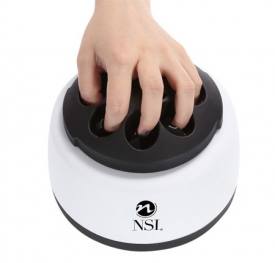
The major cause of service breakdown with any gel system is that the gel has not sufficiently cured. One cause can be the use of an incorrect lamp for a particular system. Not all lamps are created equal and some give off more UV energy than others. The Ultra Pro Full Hand Lamp from NSI emits enough UV energy for any gel product.
Using the correct lamp is just a part of the solution. Another problem is that nail technicians don’t change their bulbs frequently. A UV Lamp will go on for several years and all you see is that the light is on. The bulbs do not necessarily burn out. However, there exists the possibility that the bulbs are NOT giving off UV. Remember, just because the light it on, doesn’t mean it is emitting UV energy. UV light energy is invisible (see the visible light spectrum below).

Under curing can lead to a potentially serious problem when non-reacted ingredients are left inside the enhancement. Normally, these ingredients would react and become a permanent part of the artificial nail. Non-reacted chemicals can expose the client to ingredients that can be sensitizing with overexposure. A client might complain of itchy or warm nail beds.
Again, it is important to use the UV lamp designed for your particular UV gel system, and change the bulbs every 2 – 4 months.